



The Role of IVR in Streamlining Telecom Field Operations and Fault Management
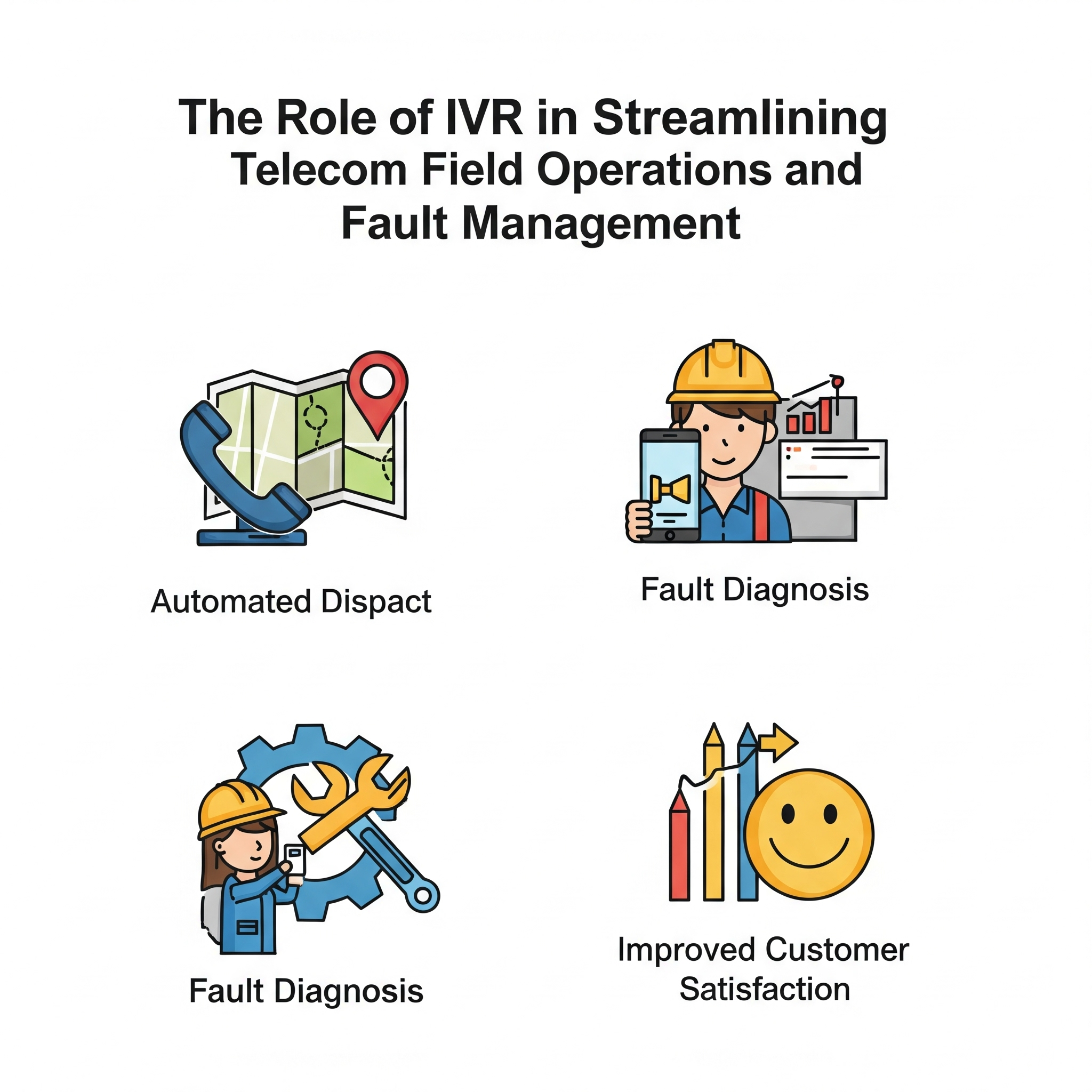
In today’s hyperconnected world telecom network infrastructure has become more complex, dynamic and mission critical than ever. From maintaining thousands of cell towers to managing sprawling fiber networks and ensuring uninterrupted mobile and broadband services, telecom providers face intense pressure to ensure maximum uptime, meet SLA commitments and respond to faults in real time.
While automation and AI are transforming many layers of telecom operations, one often overlooked tool Interactive Voice Response (IVR) is proving to be a powerful enabler especially in field operations and fault coordination within the network infrastructure domain.
The Telecom Infrastructure Challenge
Telecom infrastructure teams deal with:
-
Thousands of geographically distributed network sites (BTS, towers, data centers)
-
Complex NOC (Network Operations Center) workflows
-
High volumes of fault tickets
-
Manual field engineer dispatching
-
Delays in fault acknowledgement and closure
These operational challenges directly impact network availability and performance.
Enter IVR: A Strategic Layer for Operational Efficiency
Traditionally used in customer service IVR systems are now being repurposed and integrated within internal telecom operations especially to automate communication, trigger alerts and assist with field coordination.
Let’s explore how IVR helps reduce NOC workload and streamline telecom field operations.
1. IVR for Reducing NOC Workload
The Network Operations Center (NOC) is the brain of infrastructure management. It monitors every node, link and endpoint. But handling thousands of alerts manually can be overwhelming. IVR offers a way to automate first level communication enabling faster fault response and leaner teams.
How IVR helps:
-
Automated Fault Alerts: When a fiber cut or tower power failure is detected via NMS IVR can trigger automated voice calls to the concerned engineer or regional manager.
-
Two Way Confirmation: Engineers can press 1 to accept a task or 2 to escalate no human intervention required.
-
Load Distribution: IVR can intelligently route issues based on shift, region or availability.
Example Use Case:
A node in the Delhi West zone goes down. The IVR system auto-calls the assigned field technician. Upon pressing “1” to accept the ticket, a confirmation is logged in the OSS. NOC workload is reduced by automating call-outs and status updates.
2. IVR in Telecom Field Operations
Field operations are inherently mobile. Engineers may be unreachable by app notifications or emails while on the move. IVR provides a reliable device agnostic way to reach on ground teams in real time.
How IVR supports field work:
-
Site Visit Instructions: IVR can deliver verbal site codes, address and fault summary to engineers on call.
-
Automated Dispatch: Based on geo zones IVR connects the nearest available technician.
-
Feedback Logging: Post resolution IVR can collect verbal or keypad based status updates (“1 - Resolved”, “2 - Revisit Required” etc.)
3. IVR + NMS Integration = Real-Time, Voice-Led Fault Management
Modern IVR platforms can integrate with NMS (Network Management Systems) and ticketing tools (like Remedy, ServiceNow) to form a closed loop automation cycle:
-
NMS detects fault →
-
IVR auto calls field engineer →
-
Engineer acknowledges or rejects task →
-
Status updated in OSS/BSS →
-
Follow up or escalation triggered
This setup ensures:
-
Zero delays in field response
-
Clear ownership of every issue
-
Live feedback to central systems without needing mobile apps or emails
Technical Considerations (for Telecom Product Heads)
-
Ensure IVR platform integrates with existing OSS/BSS stack
-
Build zone wise and skill wise engineer databases
-
Use voice logs for training/failure pattern identification
-
Ensure fallback mechanisms if engineer doesn’t respond (multi-level call flows)
Final Thoughts
As telecom infrastructure grows more decentralized and mission critical automation tools like IVR can play a strategic support role especially in areas where real time communication fault agility and operational visibility are critical.
Though simple in concept, IVR when smartly integrated into the infrastructure stack can help reduce NOC workload, accelerate fault response and optimize field operations.In a world where every second of downtime counts, even a voice call can be a game changer.



 English
 Arabic
 French
 Spanish
 Portuguese
 Deutsch
 Turkish
 Dutch
Dutch
 Russian
 Romaian
 Portuguese (Brazil)
 Greek
Greek
 Telugu